01
Real-time security audits
Stop spending days prepping for audits, reviews, and executive briefings. Pull every data point you need — with true business-case impact — in minutes, instead of presenting insights that are weeks old.
Xcigence turns cyber risk into a single score, a dollar exposure and continuous compliance.
 Proud member of the

Our Technology Partners
Xcigence is a patented cyber risk rating and scoring platform built to go far beyond casual web scanning.
Entity-Based Risk – employees, contractors, vendors, privileged users
Object-Based Risk – devices, applications, cloud systems, OT/IoT, data assets
Inherent & Residual Risk Measurement – before and after controls
Continuous Risk Scoring – dynamic underwriting intelligence
Automated Regulatory Compliance Assessments – across 21 frameworks, including PCI-DSS, HIPAA, ISO 27001, GDPR, SOC 2, CCPA, PIPEDA, Bill 194, and moreExpanding coverage — coming soonNIST CSF 2.0, FFIEC, DORA, NIS2, EU AI Act, NIST AI RMF, ISO/IEC 42001
New · Agent Governance
Policy tells AI agents what they should do. Xcigence enforces it at the operational data layer, in the moment every agent acts.
Policy-only governance
Operational enforcement
Platform features
Unified risk signal coverage
Demo dataMost scanners bury you in thousands of low-value findings. Xcigence scores every finding for materiality — combining severity with real-world exploitability (FIRST.org EPSS probability and the CISA Known Exploited Vulnerabilities catalog) and its own detection confidence — so your team works the handful of issues that genuinely matter first, with the hygiene noise collapsed out of the way.
Xcigence doesn't cry wolf. Routine scan and compliance results live on your dashboard. You only get an urgent alert — a blinking CISO indicator, an email to your security lead, and an auto-generated remediation ticket — when a newly-discovered vulnerability is confirmed exploited in the wild or carries a high exploit probability. Real threats, not inbox fatigue.
Every score, dollar figure, and compliance status derives from real scan findings, published threat feeds, or your own data — with a transparent, source-cited methodology behind every number. Boards, insurers, and auditors get figures they can trust and trace.
One continuous, evidence-based picture across vendors, assets, users, and teams.
Solutions
See risk across every party you depend on.
Turn technical evidence into board-ready decisions.
Close gaps before they become incidents.
Beyond the AI dashboard
Most SOC, vulnerability management and CTEM tools rank vulnerabilities in isolation. The Xcigence approach, described in patent US 11,418,531 ("System and method for determining cybersecurity rating and risk scoring"), models how risk spreads through your business.
We go beyond scoring software assets or network perimeters. The method maps each part of your business (data stores, third-party dependencies, operational workflows and physical assets) to a risk weight that changes as conditions change.
Assets are scored as an interconnected graph rather than a flat list. When even a minor asset is compromised, the engine passes that risk along to every workflow that depends on it and recalculates the combined effect.
Instead of a high/medium/low label, the algorithm finds the single fix that removes the most system-wide risk for each unit of remediation effort.
What buyers compare us with
e.g. Tenable, Qualys
ThemTell you which vulnerabilities exist.
XcigenceShow what those vulnerabilities mean for business continuity, as a quantified score that boards and CFOs can audit.
e.g. Cymulate, XM Cyber, Balbix
ThemMap attack paths and validate exposures, often with heavy setup and computing cost.
XcigenceScore entity risk continuously, driving compliance and risk reduction without lengthy manual red-team setups.
Scripts built on CrowdStrike, Tenable and Splunk data
ThemHomegrown scores that take constant upkeep and drift over time.
XcigenceA patented scoring method that stays consistent and scales across changing supply chains.
e.g. RiskLens-style models
ThemTop-down, largely qualitative loss models that update slowly.
XcigenceBottom-up scoring of each entity that runs continuously and automatically.
Why technical evaluators choose Xcigence
A number copied from a report is a guess with a citation. These are the reasons evaluators trust a number that starts from their own evidence.
Stop spending days prepping for audits, reviews, and executive briefings. Pull every data point you need — with true business-case impact — in minutes, instead of presenting insights that are weeks old.
SOC 2, ISO 27001, GDPR, DORA, EU AI Act, HIPAA, NIST and regional frameworks, mapped for you. Xcigence shows where you have gaps, where you need to act, and where to focus time and money.
Stop spending months with auditors, system admins and consultants. Xcigence connects and X-rays digital assets, logs and other internal and external data points — surfacing security gaps, compliance errors, and active threats efficiently.
CFOs can annualize loss expectancy from substantiated data with defensible accuracy — a range backed by observed inputs, not a single number pulled from a report.
Xcigence acts as a preventive control against cyber threats and attacks from many sources — surfacing exploitable weaknesses before they are leveraged against you.
Our model takes inputs from real platform data — sector, asset exposure, in-the-wild exploitability, control maturity, compromise indicators. An evidence-readiness view lists each input as observed or not observed, explains why, and says what to do next. When there is no real signal, the model falls back on a general prior and the evidence grade drops.
A parameter counts as sourced only with validated values, a citation naming publisher, report, edition and figure, and a named independent reviewer. Sign-offs expire after a year and can be withdrawn with a reason. Until every scenario is sourced and signed off, the result is called indicative and the grade is capped.
Each run is checked against IBM industry averages and Cyentia incident probability. A result outside the expected range is a prompt to investigate, not proof of an error. If a signed-off parameter cites the same publication a check compares against, that check is labelled "not independent" — agreement with the source you copied from proves nothing.
Every result records the model version, the inputs fingerprint and the random seed. The same inputs reproduce the same figures exactly. An auditor can rerun a number and get the number.
The output is a range from a scenario model, tested against per-sector limits. It is not a forecast and not a professional opinion on any individual loss. Sector limits are proposed starting points until your risk advisers review them for your organisation.
The board's fair question
A single confident number is easy to produce and hard to trust. We built our answer around the opposite idea: every figure shows what supports it, what does not, and how it was checked.
Global average cost of a breach, up 12% year over year.
Typical chance of a significant security incident in a year.
Median reported loss ~$603K; worst 5% of incidents reach $32M.
Those figures describe populations, not your organisation. IBM's average comes from a non-statistical sample of breaches between roughly 2,600 and 115,000 records — a mean, not a worst case.
What this changes in practice
Security teams
Show which missing evidence is holding the grade down — and fix it.
Finance & risk teams
Get ranges and a sector-limit test, with every assumption visible.
Auditors & assessors
Trace a figure back to its inputs, citations and sign-offs.
See it on your own data
A short walkthrough using your sector and your assets.
Meet your AI cyber analyst
Stop digging through dashboards. Ask Xcigence any question in plain English and receive instant answers backed by live vendor, compliance, vulnerability, and supply chain intelligence.
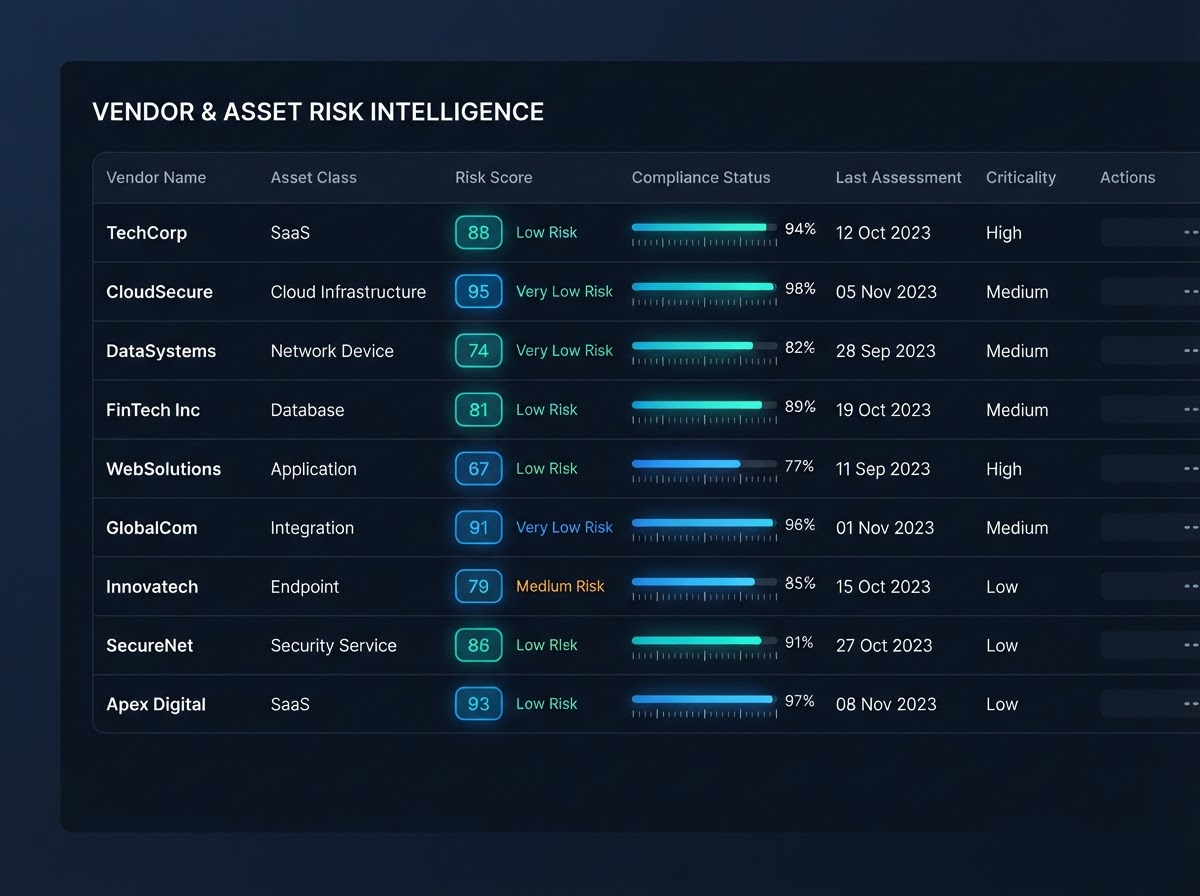
The AI intelligence layer
Find answers instantly instead of searching dashboards.
Learn more →Automatically matches new CVEs against your environment and prepares remediation actions before your team even starts investigating.
Learn more →Generate comprehensive cyber due diligence reports on acquisition targets before signing the deal.
Learn more →Evaluate and monitor AI vendors with dedicated governance, compliance, and risk controls.
Learn more →Powered by proprietary, patented algorithms, Xcigence delivers trusted, defensible cyber-risk intelligence — grounded in real evidence, never guessed.
Built from verifiable data — real scan evidence and published exploitability feeds (FIRST.org EPSS, CISA KEV), never opinion or estimate.
Explainable, source-cited scoring logic. Where an input isn't available, Xcigence shows an honest "not available" instead of a fabricated number.
A standardized 300–850 score that's audit- and regulator-ready, and traceable back to the evidence behind it.
Exploit-probability (EPSS) and confirmed-exploited (CISA KEV) signals run end-to-end — into finding priority, the CISO threat view, and imminent-threat alerting.
Recognition & partners
We would rather show you a real reference than a polished quote. Xcigence is shaped by the security, risk, and audit teams piloting it with us across media, finance, insurance, fintech, and property management. If you are evaluating cyber risk scoring and want to help steer the roadmap, we would like to talk.
NVIDIA Inception
Member program for AI startups
USPTO patent
US 11,418,531 — granted 2022
Cyberlab Inc.
Austin, TX · Toronto, ON
Organizations piloting Xcigence
Velorah
Media
All My Insurance
Insurance · Canada
Mohamad Chami, CEO
CT Finance & Mortgage Brokerage
Finance
Steve Bryan
8Twelve Financials
Finance
World Financial Group
Design partner
Mauve Living and Property
Healthcare & Building Management
Esther Olly
Matraq Integrated Limited (Cashtella)
Fintech
Afeez Moradeyo, CEO
Design partners collaborate on product direction and validation. Inclusion here does not imply a commercial endorsement.
A clearer next step
Walk through the platform with your priorities in view, or begin with a focused risk assessment.
We use cookies to improve your experience, analyze traffic, and support our marketing. See our Privacy Policy.